The following cover letter is an example of the modernization announcement sent to you. The customized data has been removed. You can have the sample letter translated into several languages here. However, for a translation of your individual cover letter, please contact a translator.
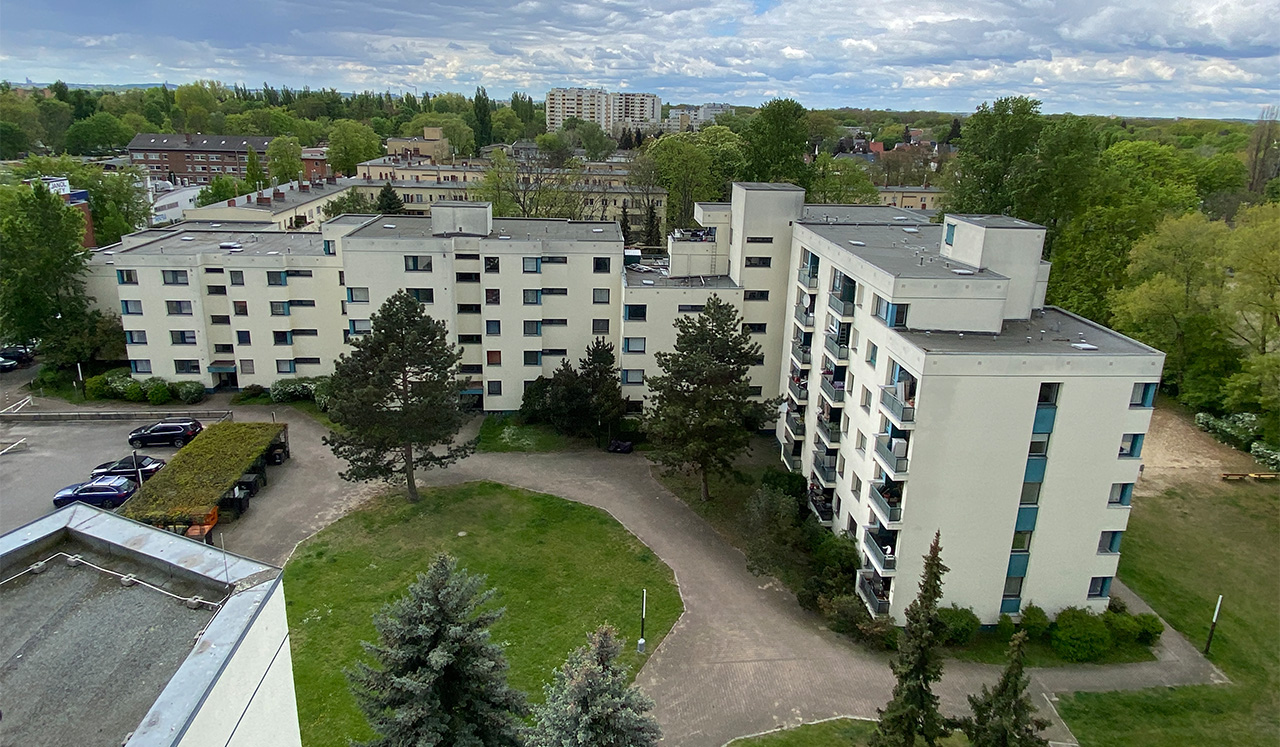
Modernizations in the Bruseberg housing estate: We are creating living spaces with a future
* This page has been translated via Google's Cloud Translation API. HOWOGE does not edit the content.
We improve your quality of life! Your house will be renovated!
Good day,
On behalf of and with the full authority of your landlord, HOWOGE Roedernallee GmbH, we inform you that we will be modernizing the residential building containing your apartment starting in June of this year. This will primarily improve your quality of life in the long term. The following measures will be carried out:
in your apartment:
- Heating work (1.*)
- Electrical (2.)
- Pipes/Sanitary facilities (3.)
- Sanitary fixtures (4.)
- Drywall and tiles (5.)
- Doors (6.)
- Window work (8.)
- Ventilation (11.)
Additionally at the residential building:
- Basement work (7.)
- Elevator work (9.)
- Fire protection (10.)
- other (12.)
*Please refer to Annex 3 for a detailed description of the measures and the planned construction times.
We would like to inform you in advance that you have the option of having a shower tray installed instead of the originally planned bathtub. Please check the corresponding box in Appendix 1 to indicate this.
We thank you for your understanding and will do our best to minimize any inconvenience.
Do you have any questions about this?
We invite you to the tenants' meeting on March 23, 2026.
To answer your questions, we will be holding a tenants' meeting on Thursday, March 23, 2026, from 5:00 p.m. to 8:00 p.m. at the clubhouse of the Reinickendorfer Füchse sports club, Kopenhagener Str. 33, 13407 Berlin or Freiheitsweg 18, 13407 Berlin. This tenants' meeting is not open to the public. Please bring a photo ID and your declaration of consent.
1. Important – please fill out and submit by April 17, 2026:
Please complete the declaration of consent (Appendix 1) and the data protection declaration (Appendix 2) in full and send them to us by April 17, 2026 at the latest to kundenzentrum@howoge.de . Alternatively, you are welcome to submit the documents at the aforementioned tenants' meeting.
2. Information on the construction period
Construction work will begin on June 15, 2026 and is expected to end on December 10, 2027 .
In order to carry out the renovation work, specialist companies commissioned by us will need access to your apartment. This will likely be necessary between July 13, 2026, and August 28, 2026. We kindly ask you to ensure that your apartment is clear enough for the construction work. We will explain the extent of this access required during a separate appointment in your apartment. We will inform you of this appointment separately. You can also find initial information in the floor plan in Appendix 6.
Should you require assistance in creating the necessary space for construction in your apartment, please contact us immediately after the on-site inspection.
If the planned construction dates are postponed (see Appendix 3), we will announce this in a timely manner. Naturally, no construction work will take place on public holidays within the specified periods.
3. Do you require support during the construction period?
If you have any questions or require assistance due to your age or physical disability, please feel free to contact us:
- by telephone: 030 / 54 64 30 00
- by email: kundenzentrum@howoge.de
4. Investment costs and modernization levy
We expect to invest a total of [ amount] in the construction project.
The costs for all maintenance work will be covered by us, HOWOGE. We will only pass on the costs for modernization measures to your total rent, in accordance with legal regulations and the requirements of the Berlin Senate.
Total cost of this measure: €4,223,438.73
Total repair costs: €3,009,033.42
Total modernization costs: €1,214,405.31
Monthly modernization levy before capping: Amount
Monthly modernization levy per m² before capping: Amount
Cap amount per m²: - Amount
Monthly modernization levy per m²: Amount
Your estimated monthly modernization levy: Amount
Please note that this breakdown is based on estimated costs. Once the construction work is completed, we will be able to inform you of the actual costs incurred and your resulting monthly charge as part of the modernization billing. At the same time, we expect the planned measures to reduce your heating and hot water costs, assuming your usage remains the same.
For this reason, we ask you to refrain from asking about the specific amount of the levy until the modernization bill is issued.
Legal information regarding the modernization project can be found in Appendix 5.
5. Affordability guarantee, hardship clause and special right of termination:
With the cooperation agreement "Affordable Rents, New Housing Construction, and Social Housing Provision," we guarantee that your rent will remain affordable. This means that the net rent (excluding utilities) may not exceed 27% of your household income, provided you meet the requirements for a housing entitlement certificate (WBS) and the living space is within the specified limits (Article 2, Section 3, Paragraph 4 of the Berlin Housing Act). If your rent is higher, you can apply for a rent reduction to this percentage of your income. Further information can be found at: http://www.howoge.de/leistbarkeitsversprechen or by contacting kundenzentrum@howoge.de .
We would like to inform you today that you may be entitled to housing benefit due to the present modernization announcement.
Please note that, in accordance with § 555d para. 2, 3, 4 of the German Civil Code (BGB), you must inform us in writing of all reasons that constitute a hardship for you due to the modernization work by the end of the month following receipt of this announcement.
Furthermore, you have a special right of termination: You can terminate the lease agreement at the end of the second month following receipt of this notice (§ 555e para. 1 BGB). The termination notice must be given by the end of the month following receipt of the modernization notice.
6. Further information for you:
More detailed information on the measures and legal notices can be found in:
- Annex 3: Description of construction measures
- Annex 4: Cost splitting and modernization levy
- Annex 5: Legal Notices
- Appendix 6: Floor plan
- Appendix 7: General Power of Attorney
Best regards
Your HOWOGE housing company mbH
Annex 1:
name
Address
HOWOGE Wohnungsbaugesellschaft mbH
PO Box 10 03 19
57003 Siegen
Declaration of Toleration
The announcement letter dated March 12, 2026, specified the start date, expected duration, type and scope of the work, as well as the expected timeframes.
I/we will tolerate the modernization and repair measures in the house announced in the letter of 12 March 2026 and will grant corresponding access to the apartment and the tenant's cellar, insofar as this is necessary for the aforementioned measures.
Berlin, the
-------------------------------------------------------------------------------------------
Signature Name
Annex 2: Tenant number: Contract
name
Address
HOWOGE Wohnungsbaugesellschaft mbH
PO Box 10 03 19
57003 Siegen
Privacy notice and statement – Sharing of contact details
In the event of necessary repairs, maintenance, renovations, refurbishments, or similar work, HOWOGE generally uses external service providers (e.g., tradespeople). In this case, scheduling an appointment between the tenant and the service provider is required. Furthermore, data must be shared with the following recipient: Studio Duktus Buser Architekten PartGmbB.
The tenant hereby consents to the following communication data being transmitted to external service providers:
☐ Phone number / Phone number ________________ /__________________
☐ Email address ____________________________________
This data will only be passed on to the external service provider so that an appointment can be arranged quickly.
Consent is given voluntarily. I/We am/are aware that this consent can be withdrawn at any time.
Even if the tenant does not consent to the aforementioned data processing, the necessary measures will be carried out. This consent is given voluntarily and can be revoked at any time without stating reasons, with effect for the future.
___________________________________________________________________
Place, Date, Signature of Tenant
We would like to refer you to our privacy policy, which you can view at any time at https://www.howoge.de/datenschutz .html.
The data protection officer can be reached at datenschutz@howoge.de.
Annex 3: Description of the construction measures
Heating work, construction period: timeframe
It's on
The heating system is a two-pipe system. The insulation of the manifold pipes in the basement has been renewed and is in proper working order. The shut-off valves have also been renewed and are freely accessible, with the exception of those located in tenant basements.
The bathrooms are equipped with panel radiators and towel radiators. Hot water is supplied by electric water heaters.
Some kitchens have panel radiators installed.
Construction measures and consequences
As part of the energy-efficient modernization, the complete replacement of the heating risers, connecting pipes, and radiators is planned. The new radiators will be larger to ensure future operation with reduced flow temperatures. The existing old heating loops will remain in the building, decommissioned.
The radiators are designed for a flow temperature of 55 °C to allow for future heating using renewable energy sources. The "Arbonia" tubular radiator type is specified.
The risers will be fully insulated and then structurally enclosed using drywall cladding or riser profiles. In addition, the existing fire barriers will be supplemented or renewed to ensure structural fire protection. Furthermore, the installation of electronically controlled balancing valves is planned to optimize hydraulic balancing.
Towel radiators will be installed in the bathrooms where they have not already been installed. Their arrangement can be found in the floor plan – Appendix 7.
In kitchens, living rooms and hallways, the heating risers, connecting pipes and radiators are being renewed, also in a design suitable for later low-temperature operation, while the old decommissioned heating rings remain in place.
Added value (before-and-after comparison)
Lowering the flow and return temperatures and insulating the heating pipes results in significantly higher energy efficiency after the renovation. The optimized temperatures reduce heat loss throughout the entire system, while the improved insulation ensures that the generated heat reaches the building much more effectively. This noticeably reduces energy consumption – a clear benefit in the form of lower heating costs and more sustainable system operation.
Measures that sustainably reduce final energy consumption are considered modernizations according to § 555b paragraph 1 of the German Civil Code (BGB).
We consider the remaining costs as repairs.
Electrical work, construction period: timeframe
It's on
Each basement level has a service connection from the energy supplier with a nominal size of 250 A. After the service connection at Thyssenstrasse 6, a main distribution panel feeds in, which supplies the apartment stairwells of the building as well as general building systems such as elevators, building lighting, exterior lighting and possibly also the laundry facilities.
It appears that the individual apartment entrances are supplied directly after the main electrical connection. Three-phase electricity meters for the apartments are located on meter panels within each apartment. Meters for the communal system and the heating are located in the main electrical connection room at Thyssenstraße 6.
The building's common areas, including utility connections, metering systems, and general lighting, date back to the original construction. Stairwell lighting is controlled by conventional push-button switches. Basement lighting uses on/off switches. Both basement and stairwell lighting uses conventional 40W incandescent bulbs.
There are Telekom distribution boxes in all stairwells in the basement. The broadband cable network (BK network) was apparently installed by Vodafone Kabeldeutschland.
The pipe network extends in a star shape to separate riser points, from where it continues into the apartments.
The sub-distribution boards are mostly located in the apartment hallway behind the entrance door. The three-phase electricity meters for the apartments are located inside the respective apartments on the meter panels.
The bathrooms and kitchens have an electric water heater.
Construction measures and consequences
As part of the planned renovation work, the building's utility connections will first be renewed and the electrical systems in the common areas will be completely modernized. At the same time, the meter locations will be centralized in accordance with DIN VDE AR N 4100 in the basements of each stairwell. In the basements, the existing installations, including switches and sockets, will be completely replaced with surface-mounted wiring.
In the stairwells, the installations will be renewed concealed within the plaster. The risers for supplying the apartments will be installed surface-mounted within the apartments. The riser shafts will be clad with drywall, as will the sub-distribution boards and multimedia distribution boards, also within drywall cladding.
The stairwell lighting will be completely renewed. LED surface-mounted luminaires with integrated high-frequency detectors will be installed for the stairwell lighting. Lighting in the utility rooms will be provided by moisture-proof LED batten luminaires. All other areas will receive appropriately functional lighting. The existing cable network will remain in place. The Telekom copper network will be renewed, as will the fiber optic building cabling (NE4) and the fiber optic building distribution box (Gf-GV) in the building's service entrance/electrical room, i.e., space will be provided for the fiber optic termination points (Gf-AP). Additionally, the fiber optic subscriber connection box (Gf-TA) will be installed in the apartments within the multimedia distribution box.
In apartments that have not yet been renovated, the electrical systems will be repaired to meet the minimum requirements of DIN 18015-2. Apartments whose existing electrical installations cannot be used further due to metrological testing will be completely rewired. In apartments where the installation meets the metrological requirements, the existing system will continue to be used. These apartments will also receive a separate circuit for the washing machine. Wiring in hallways and on thin partition walls up to a maximum of 8 cm thick will be installed horizontally in surface-mounted cable trays. In bathrooms, the electrical installation will be completely replaced with concealed wiring. New distribution boards with steel doors will be installed: four-row for single-room apartments and five-row for multi-room apartments.
Finally, the electrical installations in the bathrooms and kitchens will be completely renewed and expanded as needed to ensure safe and up-to-date use of modern kitchen appliances.
Added value (before-and-after comparison)
By modernizing the outdated electrical system, the entire installation is brought up to current technical standards, making it significantly safer and more efficient. While the previous installation, due to its age, offered only limited safety features and in some cases no longer met current standards, the renewed and expanded safety-relevant components now ensure reliable protection against electrical hazards such as overload, short circuits, and fault currents. The modernization also leads to a more stable power supply, enables the safe operation of modern household appliances, and simultaneously reduces the overall system's susceptibility to malfunctions. Overall, the upgrade creates significant added value: the electrical infrastructure is not only safer and more efficient, but also increases living comfort and the building's future viability.
This leads to a lasting improvement in general living conditions and, according to Section 555b Paragraph 5 of the German Civil Code (BGB), qualifies as a modernization. We will include the costs, less the repair portion, in the modernization costs.
Pipes/Sanitary facilities, Construction period: Period
It's on
The drinking water connections at Thyssenstrasse 8 and 12 supply the respective building entrances and show severe corrosion. Distribution and riser pipes are made of galvanized steel and date back to the original construction period. The buildings only have a cold water supply; hot water is generated decentrally via electric instantaneous water heaters, some of which have already been replaced.
Wastewater and rainwater are conveyed via collection pipes located in the basement to the house connections in the buildings at Thyssenstraße 6, 8 and 12. The pipes are predominantly made of fiber cement and have been locally renovated.
The bathrooms have separate sewage and cold water lines. Kitchens, if separate from the bathroom, sometimes have their own pipework. Most apartments have fitted kitchens.
Construction measures and consequences
The construction work includes the renewal of the wastewater connection and the complete replacement of the drinking water risers and distribution pipes, including insulation and fire barriers. New pre-wall elements will be installed in the sanitary areas; the decentralized hot water system will remain, although the electric instantaneous water heaters will be inspected and mostly replaced. The apartment plumbing will be renewed according to current hygiene standards, supplemented by automatically backwashable drinking water filters at the building's water inlets. A connection test is required for the building at Thyssenstraße 8 due to insufficient water pressure. In addition, the downpipes and collector pipes for wastewater and rainwater will be completely renewed with sound-insulated pipe systems, and the main drainage pipes will be inspected and, if necessary, repaired. The bathrooms and kitchens will be completely renovated and equipped with new sanitary installations and drainage pipes.
The costs of this measure are considered entirely as repairs.
Sanitary fixtures, construction period: timeframe
It's on
The bathrooms are equipped with a washbasin, a bathtub or shower, and a floor-standing toilet with a surface-mounted cistern. There are a total of four shower rooms. Each kitchen has a sink connection.
Construction measures and consequences
Since the existing sanitary fixtures and fittings are worn out, technically outdated and no longer meet modern standards, we will completely renovate the bathrooms.
Among other things, we will install a wall-hung toilet with a concealed cistern and economy button in a pre-wall element.
After the upgrade, you'll benefit from modern, functional, and visually appealing fixtures that significantly improve comfort, hygiene, and design. In the kitchen, the existing sanitary fixtures will be retained, but they will be fitted with new connections. Previously, the plumbing may not have been optimally installed or may not have met current standards. After the upgrade, the new connections ensure a reliable water supply and safe, compliant use of the existing appliances, without the need for a complete renovation.
Added value (before-and-after comparison)
The installation of a wall-hung toilet with a concealed cistern and dual-flush button improves the rental property and saves water compared to the existing floor-standing toilet and exposed cistern. We will classify the costs accordingly as modernizations under Section 555b, Paragraphs 1 and 5 of the German Civil Code (BGB).
We consider the remaining costs as repairs.
Drywall and tiling, construction time: period
It's on
In the bathrooms, the walls are tiled up to door height, while the upper wall surfaces and ceilings are plastered, covered with woodchip wallpaper, and painted. The floors are tiled and equipped with a floor drain. In the kitchens, the walls in the wet area are tiled, while the upper wall surfaces above are finished with plaster, woodchip wallpaper, paint, or other wall coverings. The ceilings are plastered, covered with woodchip wallpaper, and painted.
Construction measures and consequences
We will be replacing the wall tiles in the bathroom (tile over tile; 30 x 60 cm; matte white). The walls exposed to splashing water will be tiled to a height of approximately 2.10 m in the bathtub and shower area. In the toilet and sink area, the tiles will be tiled to a height of 1.20 m.
Remaining wall tiles and other wall surfaces are filled and painted.
Furthermore, we will renew the floor tiles (tile on tile; 30 x 60 cm; color grey or light beige, can be selected).
A construction office will be provided for this purpose.
The upper wall and ceiling surfaces will be repaired using painting techniques and filled with a white coat of paint.
In the kitchen, we will coat the service shaft with a scrub-resistant surface. The tile panels in the kitchens will be replaced.
In connection with the renewal of the electrical wiring and the installation of the new sub-distribution board, the drywall shaft cladding will be renewed.
We will classify the costs entirely as repairs.
Doors, construction time: period
It's on
The bathroom doors are made of wood, have no glass panels, and feature ventilation grilles. The kitchen doors are also made of wood and have no glass panels.
Construction measures and consequences
As part of the renovation work, including carpentry and painting, the wooden bathroom doors are being refurbished to maintain their functionality and improve their appearance. The wooden kitchen doors without glass panels are being shortened as needed to implement the ventilation concept; this ensures sufficient air circulation without compromising the doors' visual design.
We will classify the costs of this measure as repairs.
Basement work, construction period: timeframe
It's on
The building's basement currently has a reinforced concrete ceiling with a U-value of 1.04 W/(m²K), which does not meet the required minimum thermal insulation standards. The exterior walls are constructed of 30 cm thick sand-lime brick masonry, while the partition walls between the basement rooms are made of 11.5 cm masonry or 24 cm reinforced concrete. The partition walls of the tenant storage rooms are constructed of wooden slats. The floors are made of screed. The basement areas include bicycle storage rooms and hobby rooms with a ceiling height of typically 2.20 m. Overall, the current condition does not meet either energy efficiency or modern building standards.
Construction measures and consequences
As part of the construction project, the basement ceiling will be retrofitted with 14 cm thick insulation of thermal conductivity group 035 according to BEG EM to improve thermal insulation and reduce energy loss. Additionally, new rooms will be built to house the centralized metering system, in accordance with the electrical planning specifications. During the work, temporary disruptions in the basement areas, construction noise, and dust are to be expected. Upon completion of the work, residents will benefit from improved energy efficiency, standards-compliant building services, and a functional and secure housing for the metering equipment.
Added value (before-and-after comparison)
The building's basement currently has an uninsulated reinforced concrete ceiling, resulting in inadequate thermal insulation and significant energy losses. Retrofitting 14 cm of insulation with a thermal conductivity of 035 W/(m·K) according to BEG EM standards will significantly improve the U-value, noticeably reducing energy consumption and bringing thermal insulation up to current standards. Additionally, new rooms will be created to house the centralized metering system, as specified in the electrical design, ensuring that the building services are installed in a compliant and functional manner. Upon completion of these measures, residents will benefit from energy-efficient, comfortable, and hygienically sound basement areas.
Measures that sustainably reduce final energy consumption are considered modernizations according to § 555b paragraph 1 of the German Civil Code (BGB).
We consider the remaining costs as repairs.
Window work, construction period: timeframe
It's on
The apartments in the existing building are predominantly equipped with wood-framed composite windows. Loggia and terrace windows open outwards, while the bathroom windows have decorative glass. Some ground-floor apartments have roller shutters. The U-value of the windows is 2.70 W/(m²K), and that of the roller shutters is 3.60 W/(m²K), meaning the required minimum thermal insulation is not met. A small number of existing windows have already been replaced with double-glazed PVC windows, although the construction date of most of these windows is unknown. The stairwells are fitted with single-pane wooden windows with a U-value of 5.00 W/(m²K), which also fails to meet the minimum thermal insulation requirements. Overall, the existing windows do not meet current energy efficiency standards.
Construction measures and consequences
As part of the construction project, the windows in the apartments and stairwells will be replaced with modern PVC windows compliant with BEG EM standards, achieving a U-value of ≤ 0.95 W/(m²K). The roller shutter boxes will also be replaced, achieving a U-value of ≤ 0.70 W/(m²K). French doors will be inward-opening to enhance living comfort. Additionally, window vents will be installed, and the vertical and horizontal reveals will be painted with mineral-based paints to ensure adequate ventilation and prevent mold growth. During construction, residents should expect temporary disruptions, noise, and dust. Upon completion of the project, residents will benefit from significantly improved thermal insulation, increased energy efficiency, hygienically clean interiors, and enhanced living comfort.
The window work in your apartment is expected to take 3 days. The exact date will be announced in due course by the construction company.
Added value (before-and-after comparison)
Replacing windows improves living comfort and reduces heating costs. The information provided applies to most window types and may vary slightly depending on the specific window.
Measures that sustainably reduce final energy consumption are considered modernizations according to § 555b paragraph 1 of the German Civil Code (BGB).
We consider the remaining costs as repairs.
Elevator work, construction period: timeframe
It's on
The elevators are largely still in their original, unused condition. Due to their age of over 50 years and the wear and tear of the existing components, trouble-free and reliable operation can no longer be guaranteed. The supply of spare parts is no longer assured, meaning that very long downtimes are to be expected in the event of malfunctions or repairs. Overall, the systems no longer meet current requirements for operational safety and availability.
The elevators date from 1972 and have a load capacity of 300 kg and a cabin size of 1,000 × 810 mm. The machine room is separate. Over time, minor modernizations have been carried out, including the installation of an emergency call device, a speed limiter, and the replacement of the shaft and car doors with two-part, side-opening sliding doors with a door width of 800 mm.
Construction measures and consequences
The elevator system is being completely modernized and replaced with a state-of-the-art, machine-room-free unit. All components are new, the cabin dimensions are increased to 1,000 x 1,000 mm, and the load capacity is raised to 500 kg. A GEG (German building energy efficiency standard) kit and a manual fire alarm button are integrated. The use of a block frame instead of a wall-mounted frame optimizes the use of limited space. This upgrade improves operational safety, increases passenger capacity, and ensures reliable operation while meeting fire safety requirements.
Added value (before-and-after comparison)
The existing elevators were largely in their original 1972 condition, showed signs of age-related wear and tear, and were prone to breakdowns. Spare parts are no longer available, meaning that long downtimes were to be expected in the event of malfunctions, which negatively impacted tenant satisfaction.
Following a complete refurbishment, the elevators will be installed as modern, machine-room-free replacement systems. They will feature larger cabins with a load capacity of 500 kg, all components will be new, and the systems will be more robust and vandal-resistant. The installation of the GEG kit and the new technical components will save energy, reduce maintenance costs, and significantly increase operational reliability.
Overall, the modernization significantly improves the functionality, reliability and energy efficiency of the elevators, leading to higher tenant satisfaction and lower operating costs in the long term.
This leads to a lasting improvement in general living conditions and, according to § 555b paragraph 5 of the German Civil Code (BGB), is considered a modernization.
We consider the remaining costs as repairs.
Fire protection, construction period: timeframe
It's on
The vertical pipes running through the ceilings between apartments are inadequately sealed. This can lead to noise pollution, increased fire spread, and moisture damage.
Construction measures and consequences
Fire barriers are planned for the installation of new pipes. Sealing pipe penetrations improves both sound insulation and fire protection between apartments.
We will classify the costs of this measure as repairs.
Ventilation, construction period: timeframe
It's on
The building contains eleven interior bathrooms, which no longer meet current technological standards.
Construction measures and consequences
We will renovate the ventilation system in the eleven interior bathrooms in accordance with the applicable guidelines.
Added value (before-and-after comparison)
These measures improve air quality and protect against moisture and mold. The fans will operate more quietly and reliably.
This leads to a lasting improvement in general living conditions and, according to § 555b paragraph 5 of the German Civil Code (BGB), is considered a modernization.
We consider the remaining costs as repairs.
Other, construction period: period
It's on
The following findings were recorded during the preliminary sampling of the buildings:
Contains asbestos: Floorflex tiles, sewage pipes [AZ pipes], window putty, basement windows
Mineral wool: Pipe insulation (heating / water): Mineral wool with WHO fibers Ki < 30
Lead-containing: paints, windows, doors, railings
pollutant-free: Pipe seal [wall penetration], window putty for apartments and stairwells, tile adhesive, roof sealing: bitumen, plaster/filler, wall paint
Construction measures and consequences
Deconstruction and disposal: Floorflex panels in 5 vacant apartments, asbestos-containing Floorflex panels [where still present] in small areas during riser renovation in kitchens [renewal of I-shaft] and hallways [installation of electrical riser],
Wastewater pipes [AZ pipes] as part of riser renovation, paints windows and apartment doors as part of component renewal, consideration of relevant regulations when processing/repairing interior doors during carpentry and painting work.
In accordance with official regulations, hazardous materials are professionally dismantled and disposed of by companies with appropriate authorization in small areas with low intervention depth and exposure, with the utmost care.
During the construction period in bathrooms and kitchens, shower, washing and toilet containers as well as storage containers for basement inventory will be set up for use by the tenants.
At the start of the construction work, a bulky waste container will be set up, into which the tenants can dispose of bulky waste accordingly.
Pollutants are removed as far as possible during the remediation work.
We will classify the costs of this measure as repairs.
Annex 4: Cost splitting and modernization levy
Calculation basis:
Total living area: 4,760.81 m²
Your living space: m²
Residential units: WE
| trade | Total costs including ancillary construction costs in € | Maintenance costs in € | Modernization costs in € | Modernization surcharge in €/m² |
| 1. Heating work | €595,706.23 | €481,001.54 | - | - |
| 2. Electrical | €704,420.20 | €294,188.17 | - | - |
| 3. Pipes/Sanitary facilities | €422,675.60 | €422,675.60 | - | - |
| 4. Sanitary ware | €283,671.59 | €238,950.14 | - | - |
| 5. Drywall and tiles | €951,527.75 | €951,527.75 | - | - |
| 6. Doors | €73,837.09 | €73,837.09 | - | - |
| 7. Basement work | €70,078.00 | €5,645.00 | - | - |
| 8. Window work | €703,641.49 | €245,321.63 | - | - |
| 9th elevator | €293,853.36 | €176,530.36 | - | - |
| 10. Fire protection | €50,579.40 | €50,579.40 | - | - |
| 11. Ventilation | €10,170.24 | €5,498.96 | - | - |
| 12. other | €137,114.87 | €137,114.87 | - | - |
| sum | €4,223,438.73 | €3,009,033.42 | - | - |
To keep your rent burden as low as possible, we will limit the modernization surcharge to a maximum of €2.00/m² of living space within six years, based on the applicable cooperation agreement between the Berlin Senate and the state-owned housing companies. Since the aforementioned modernization surcharge is higher than €2.00/m², it will be capped . The modernization surcharge as stated on page 2 of this letter, under point 3, applies; this amounts to € __ per month for your apartment.
Annex 6: Legal information regarding the upcoming modernization
Pursuant to Sections 555a, 555b, and 555d Paragraph 1 of the German Civil Code (BGB), you are obligated to tolerate maintenance and modernization measures. We therefore request that you declare your acceptance of the announced measures (Appendix 1) and provide your consent to the transfer of personal data (Appendix 2).
Please feel free to use the contact methods described above.
As you have gathered from our previous explanations, some of the measures implemented qualify as modernization, as they improve the rental property and save on heating energy and water – in accordance with Section 555b, Nos. 1 to 7 of the German Civil Code (BGB). Pursuant to Sections 559 et seq. of the German Civil Code (BGB) and the regulations in the Berlin Housing Supply Act (WoVG Bln) or the applicable cooperation agreement between the Berlin Senate and the municipal housing companies, we are entitled to distribute the resulting modernization costs among the individual apartments in a reasonable proportion.
According to legal regulations, we can increase the annual rent by 8% of the incurred costs, § 559 para. 1 of the German Civil Code (BGB). To keep your rent burden as low as possible, we will limit the modernization surcharge to a maximum of €2.00/m² of living space within six years, based on the applicable cooperation agreement between the Berlin Senate and the state-owned housing companies. The exact calculation basis and the resulting rent increase will be taken into account at the time of billing.
Since this is an energy-efficient renovation, we would like to politely point out that the legislator has excluded the right to a rent reduction for a period of three months with § 536 para. 1a BGB.
Appendix 7: General Power of Attorney
HOWOGE Roedernallee GmbH, represented by its managing directors Mr. Ulrich Schiller and Ms. Katharina Greis, hereby authorizes
HOWOGE Wohnungsbaugesellschaft mbH,
represented by the managing directors
Mr. Ulrich Schiller and Mrs. Katharina Greis
Stefan-Heym-Platz 1, 10367 Berlin,
to issue the following legally binding declarations to the tenants and to conclude agreements with the tenants:
- Modernization and repair announcements
- Rent increase notices in accordance with Sections 558 et seq. of the German Civil Code (BGB).
- Modernization agreements, other amendments or agreements to increase the net rent
- Operating and heating cost statements
- Warnings, admonitions
- Terminations
- Amendments or agreements regarding changes to the leased property; agreements regarding the purchase of furnishings
- Setting deadlines
The power of attorney is valid until revoked and includes the right to grant sub-powers of attorney.
HOWOGE Roedernallee GmbH